
Tata Motors expands its market leadership in India's electric passenger vehicle (ePV) segment, capturing 39 per cent of the market in Q1FY27, while simultaneously strengthening its position as the nation's second-largest carmaker amidst fierce competition and rapid market growth.

Commercial vehicle manufacturer Tata Motors Ltd reported an impressive 83 per cent increase in consolidated net profit, reaching Rs 2,556 crore for the first quarter ending June 30, primarily boosted by a significant mark-to-market gain on investments in Tata Capital Ltd.

Tata Motors Passenger Vehicles (TMPV) reported Q1FY27 results showing significant margin pressures at both Jaguar Land Rover (JLR) and its domestic operations, despite strong volume growth in the India business. Analysts expect these margin headwinds to persist, potentially offsetting gains from increased sales and new launches.

Tata Motors Passenger Vehicles is gearing up for the next phase of electric vehicle adoption in India, targeting over 30% EV penetration by FY31. The company plans to launch four new products and over ten refreshes by FY31, expanding its portfolio to ten EV nameplates. This strategy aims to move beyond early adopters to engage the early and late majority consumers, focusing on enhanced range, faster charging, and improved battery technology.

With its Battery-as-a-Service (BaaS) model Tata Motors just redrew the EV battle lines, says Rajesh Karkera/Rediff.com

Leading automakers in India, including Maruti Suzuki, Tata Motors, Mahindra & Mahindra, and Hyundai, reported increased vehicle dispatches to dealers in February, driven by sustained domestic demand.
Leading automakers in India, including Maruti Suzuki, Tata Motors, Mahindra & Mahindra, and Hyundai, reported increased vehicle dispatches to dealers in February, driven by sustained domestic demand.

Tata Motors' commercial vehicle (CV) business debuted on the BSE on Wednesday, completing the automaker's long-planned demerger into separate listed entities for its passenger and CV operations.

Tata Group stocks experienced a significant decline, with TCS falling nearly 6 per cent, after Tata Sons Chairman N Chandrasekaran announced he would not seek reappointment when his current term concludes on February 20, 2027.
At an aggressive starting price of 18.79 lakh, the Tata Sierra.ev has a real-world range of 510 to 530 km with the 75 kWh battery pack on a single charge while the smaller 63 kWh battery coughs out a real-world range of 440 to 460 km, plus lifetime battery warranty as standard. And with the intelligent Quad-Wheel Drive system pushing out 504 Nm of torque, the EV flies from 0 to 100 km/h in just 5.8 seconds, says Rajesh Karkera.

'... that work is done. The task is to reallocate what has been built, with the courage of a founder and the discipline of an owner.'
Moody's Ratings on Monday downgraded Tata Motors' outlook to negative from positive following a cyber attack on its British arm Jaguar Land Rover which has led to a complete production halt. The rating agency affirmed the Mumbai-based auto major's Ba1 corporate family rating (CFR).

Tata Sons Chairman N Chandrasekaran has announced he will not seek reappointment when his current term concludes on February 20, 2027. This decision follows a lack of unanimous board support for his extension, despite recommendations from the majority shareholders, the Sir Dorabji Tata Trust and Sir Ratan Tata Trust. Chandrasekaran cited the need for leadership clarity amidst strategic projects and has requested the board to initiate a succession plan.
Mahindra and Mahindra (M&M) recorded the sharpest acceleration among large players, with EV retail jumping to 33,513 units from 7,139 units, an almost 5-fold jump, aided by strong demand for new launches.

N Chandrasekaran, the current Chairman of Tata Sons, has announced he will not seek reappointment when his term concludes on February 20, 2027, following a lack of unanimous board support for his extension.

'whom he believes in ... or whom he has faith in. But we don't know whether that person will be competent or not. This will lead to a lot of uncertainty in the minds of investors and shareholders of the Tata group companies.'

Natarajan Chandrasekaran, credited with stabilising Tata Sons after a boardroom coup and overseeing significant expansion, has announced his resignation as chairman, capping a nearly decade-long tenure marked by both successes and escalating tensions with the group's controlling charitable trusts.

Maruti Suzuki India and Tata Motors on Monday announced plans to increase vehicle prices from April, the second time in this year, in order to partially offset the impact of rising input costs. Maruti Suzuki said it plans to hike prices of its entire model range by up to 4 per cent from next month.

'The reported deal between the European Union and China should mitigate it (shortage) for the medium to long term. Let's wait and watch how this plays out.'

Why is Shailesh Chandra, managing director of Tata Motors Passenger Vehicles and Tata Passenger Electric Mobility, not worried about the competition?
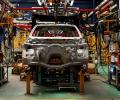
Passenger vehicle dispatches in the domestic Indian market are estimated to have surged by 33 per cent to approximately 4.7 lakh units in July, with market leaders Maruti Suzuki and Hyundai reporting record sales, alongside significant growth from Tata Motors and Mahindra & Mahindra.
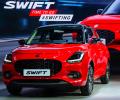
Passenger vehicle sales in India are estimated to have surged by nearly 25 per cent in June 2024, reaching approximately 4 lakh units, with Maruti Suzuki, Tata Motors PV, and Mahindra & Mahindra leading the growth, despite concerns over geopolitical tensions and monsoon impact.
Spreading risks in sourcing raw materials for electric vehicle (EV) manufacturing is "very critical" and the government can play a key role by enabling access to these from multiple locations worldwide, said Vivek Srivatsa, chief commercial officer at Tata Passenger Electric Mobility, on Friday while stressing the need for faster localisation, especially of batteries.

The Harrier EV is the first mainstream EV in India to offer a dual-motor, all-wheel-drive (AWD) which the company has termed as QWD, The Quad Wheel Drive, reports Rajesh Karkera.

N Chandrasekaran will step down as chairman of Tata Sons in February 2027, concluding a decade at the helm, following a prolonged standoff over his reappointment with Tata Trusts Chairman Noel Tata.
Electric passenger vehicle (PV) retail sales jumped more than twofold in September with Tata Motors (TaMo) leading the pack having over 6,000 registrations and a 40 per cent market share.

JSW MG Motor India has unveiled ADAPT, India's first multi-powertrain new energy vehicle (NEV) platform, designed to support electric, hybrid, plug-in hybrid, and range-extender electric vehicles. The company plans to launch one electric SUV and one plug-in hybrid SUV based on this architecture during FY27, aiming to broaden its NEV portfolio and accelerate adoption in India.
Tata Motors is hoping to beat its target year of 2030 and have 30 per cent of its portfolio comprising electric vehicles (EVs), according to Chairman N Chandrasekaran, who was speaking at the company's last annual general meeting (AGM) ahead if its demerger.

Tata Motors on Friday said it will cut passenger vehicle prices ranging between Rs 65,000 and Rs 1.45 lakh effective September 22 to pass on the full benefit of GST reduction to customers. The Mumbai-based auto major said that its small car Tiago will see a price drop of Rs 75,000, Tigor Rs 80,000, and Altroz Rs 1.10 lakh.

Chandrasekaran's exit is more than a change of chairman. It represents the breakdown of the informal consensus that governed the Tata system under Ratan Tata.

Tata Motors has inked a pact to acquire Ford India's Sanand-based manufacturing plant for Rs 725.7 crore, as it aims to bolster its passenger vehicle production capacity. As part of the deal, Tata Motors will get the entire land and buildings, vehicle manufacturing plant along with machinery and equipment situated therein, the Mumbai-based auto major said in a statement. The deal also includes the transfer of all eligible employees, it added.

Tata Motors surpassed Maruti Suzuki (India) (MSIL) to become the most-valuable automobile company, in terms of market capitalisation (mcap), after a gap of seven years. With this, the company's stock hit a new high on the BSE on Tuesday (January 30). The combined mcap of Tata Motors (Rs 285.51 crore) and Tata Motors DVR (Rs 29,119 crore) stood at Rs 3.146 trillion.

Long standing number two passenger vehicle maker in India, Hyundai Motor India, has slipped to fourth position in the domestic market in terms of retail sales last month behind Maruti Suzuki India, Mahindra & Mahindra and Tata Motors, as per the latest data shared by dealer's body FADA. Hyundai Motor India clocked retail sales of 38,156 units last month, a dip of 20 per cent as compared with 47,540 units in February last year.

JSW Motors, part of the JSW group, is set to enter India's passenger vehicle market with plans to launch 15 new-energy vehicles (NEVs) over the next four years, with deliveries commencing from December 2026.

Want to know why Pratap Bose, Chief Creative and Design Officer at Mahindra Global Design thinks so?

New players like Maruti Suzuki, VinFast, and Tesla are significantly expanding India's electric passenger vehicle (e-PV) market, capturing an 8.1 per cent share and contributing 18 per cent of incremental registrations in the first half of 2026, according to Fada Research data.

"There is a sharp jump that we have seen in bookings of EVs... The jump, at least in our case, in just two months, it is about 2 to 2.5 times of what it used to be"

Analysts predict that crude oil prices, geopolitical tensions in West Asia, and upcoming inflation data will be the primary drivers of the Indian stock market this week, alongside foreign investor activity and domestic quarterly earnings.

Indian passenger vehicle manufacturers are significantly increasing production and stocking dealerships in anticipation of strong festival season demand, with new launches planned and supply bottlenecks being addressed. However, the industry faces potential moderation in growth during the second half of FY27 due to a high base from last year's post-GST surge, commodity inflation, and elevated inventory levels.
Tata Motors reported a consolidated net profit of Rs 17,483 crore (adjusted for exceptional gains and losses) for Q4FY24, surpassing TCS' consolidated net earnings of Rs 12,434 crore. For the automotive major, this marked a 213.7 per cent year-on-year increase in the bottom line, from Rs 5,573.8 crore a year ago. In contrast, India's biggest IT firm saw a more modest Y-o-Y growth of 9.1 per cent in net profit, from Rs 11,392 crore.
